
Virginia Death Records
Virginia death records are official documents that capture key facts about each death in the Commonwealth. The Virginia Department of Health Office of Vital Records holds certified copies for events dating back to June 1912, with older records available through the Library of Virginia. You can search for Virginia death records online, visit a local office in person, or request copies by mail. Whether you need a certified copy for legal purposes or want to trace a family member, this guide covers where to look, what you need, and how to get what you ask for.
Virginia Death Records at a Glance
Where to Find Virginia Death Records
The Virginia Department of Health Office of Vital Records is the primary place to request certified death certificates. The office is at 8701 Park Central Drive, Suite 100, in Richmond, and it holds death records from June 1912 to the present. For deaths registered between 1853 and 1896, the Library of Virginia at 800 East Broad Street in Richmond is the right place to go. The Library holds those older records on microfilm and lets the public view them free of charge. Records from 1896 through June 14, 1912, generally do not exist because Virginia had no law requiring death registration during that period.
Walk-in service is available at several locations. The Richmond office accepts walk-ins Monday through Friday from 7:00 AM to 4:00 PM. Local health departments and DMV locations across the state also provide vital record access during normal business hours. Call ahead before visiting any local office to confirm they handle death records at that specific address, since vital records may be issued at a different address than the main health department building.
Death records 25 years old or older are public information under Virginia law. Anyone may request a Verification of Death for older records. Full certified copies of death certificates, however, are still limited to immediate family members regardless of the record's age. Circuit courts handle related documents such as probate filings and estate records. The Virginia Judicial System circuit court directory lists every court in the state with clerk contact information for each county and independent city.
The VDH Contact Us page has the main office address, mailing address, phone number, and email for questions. The Customer Care Center at 804-662-6200 is open Monday through Friday from 8:00 AM to 4:30 PM.
The Virginia Department of Health Office of Vital Records website provides direct access to online applications, walk-in location details, and contact information for the state vital records system.
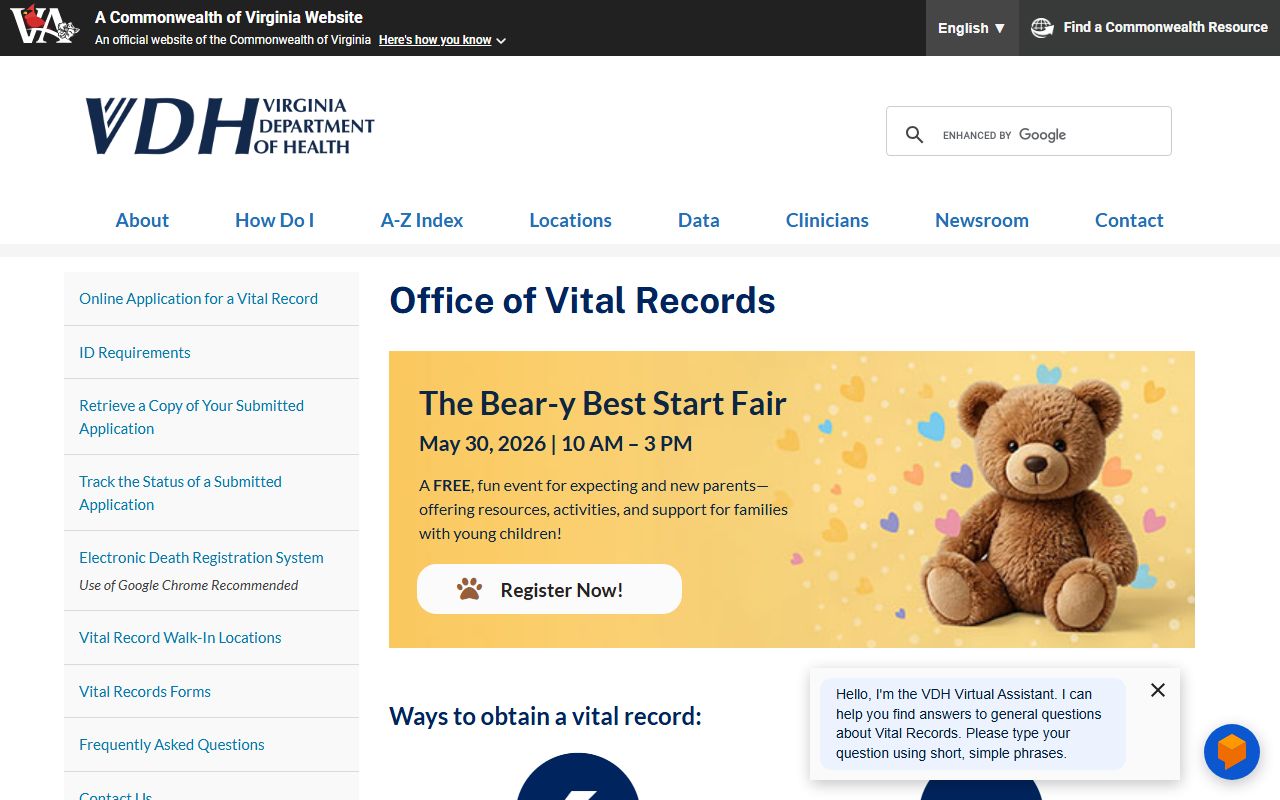
The VDH Vital Records office processes both standard and expedited requests for death certificates across all of Virginia's counties and independent cities.
How to Request a Virginia Death Certificate
The fastest way to get a Virginia death record is through the Office of Vital Records Online Application Portal. You fill in an online form with information about the decedent, including their name, date of death, and location of death. Next, you upload a legible copy of your photo ID and sign the application electronically. You pay by credit card when you submit. The portal assigns a tracking ID to your application and sends email and text updates on its status. Online requests are typically processed in 5 business days, though requests that require amendments take longer.
Mail requests go to the Office of Vital Records at P.O. Box 1000, Richmond, Virginia 23218-1000. Download the application form from the VDH website, complete it, and send it with a check or money order made payable to the State Health Department. Do not mail cash. Mail applications take about 8 business days from the date the office receives them. Amendment requests take additional time regardless of how you submit, so the office recommends mailing those rather than dropping them off in person.
Walk-in requests at the Richmond office are handled the same day. No appointment is needed. Drop-off requests are also accepted at the front desk and can be mailed back to you or held for pick-up. Pick-up requests must arrive no later than 2:00 PM and will only be released to the person who submitted them.
The VDH walk-in locations page lists every health department and DMV location in the state where you can request records in person. Not every location offers the same services. It is strongly recommended to call ahead and confirm before making the trip.
The Office of Vital Records Online Application Portal walks you through each step and lets you track your request from start to finish.
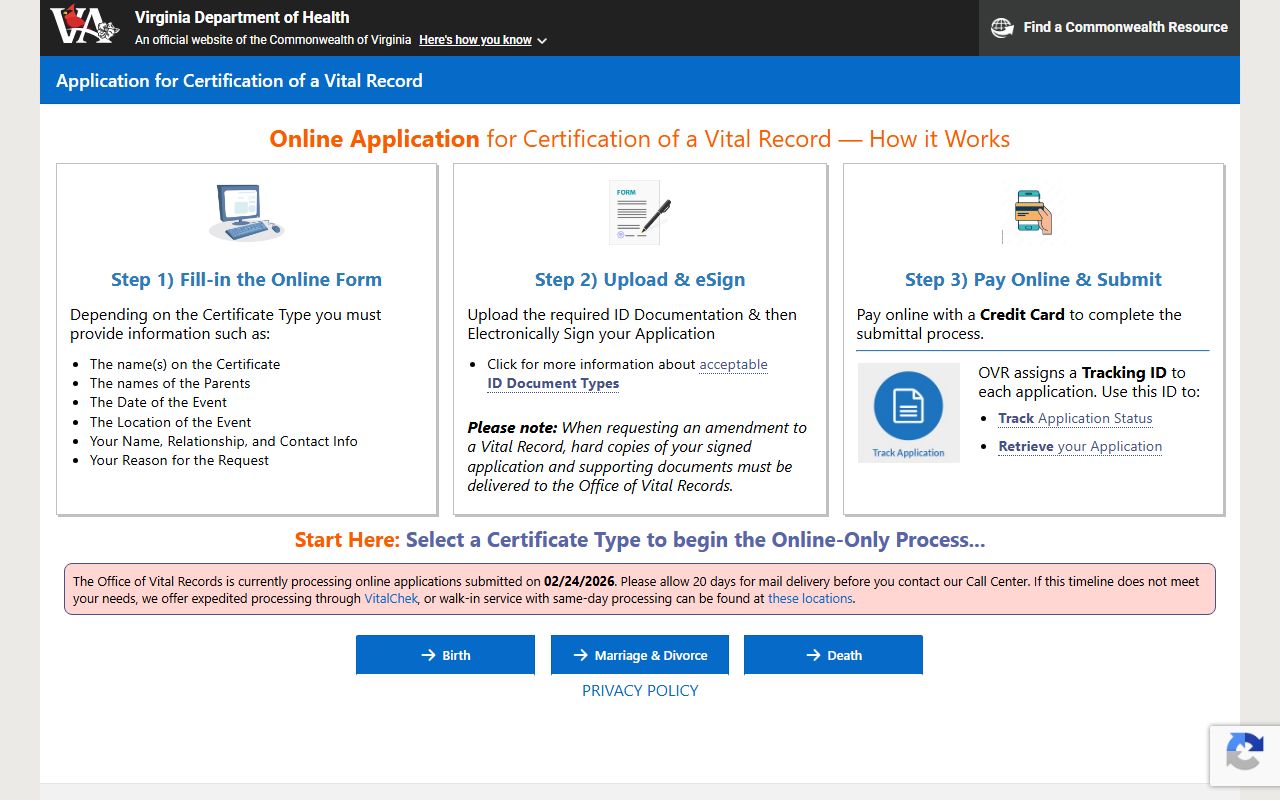
After you submit, you receive a tracking ID you can use to check your application status at any time through the same portal.
Express Delivery Through VitalChek
If you need your Virginia death certificate quickly, the VitalChek Network is the state's authorized partner for expedited processing and delivery. You can reach VitalChek at 877-572-6333 or through www.vitalchek.com. Press option 1 to place a new order or option 2 to check the status of an existing request. Payment must be by credit card. All major cards are accepted.
The cost for a Virginia death certificate through VitalChek is $20.80 per certified copy, plus a non-refundable VitalChek service fee of $12.70. Delivery options are added on top of that. UPS Air costs $19.50, UPS 2-Day Air costs $18.00, and standard USPS mail has no additional delivery fee. VitalChek cannot ship to a P.O. Box. The VDH typically processes VitalChek requests within 2 to 5 days before shipping.
To place an order, you need the full name of the decedent, date and place of death, your relationship to the person on the certificate, and a valid mailing address. All fees listed are subject to change.
Who Can Obtain Virginia Death Records
Full certified copies of Virginia death certificates are available only to immediate family members. That includes the decedent's mother, father, current spouse, children, brothers, sisters, and grandparents. Each person requesting a record must show a valid ID. Under Virginia Code § 32.1-271, aunts, uncles, cousins, in-laws, and anyone else outside that immediate family list cannot receive a certified copy of a death certificate.
Non-family members may request a Verification of Death if they can show a direct and tangible interest in the record. A Verification of Death is limited. It shows the decedent's name, date of death, place of death, date of birth, and the last four digits of the Social Security Number. It does not include cause of death or other detailed information from the full certificate. If you're unsure whether you qualify, contact the VDH Customer Care Center at 804-662-6200 before submitting your request.
If you cannot meet the ID requirements, a qualifying immediate family member can make the request on your behalf. A legal representative holding a properly executed Power of Attorney may also be eligible. The State Registrar reserves the right under § 32.1-271(C) to accept or deny any application.
The VDH Frequently Asked Questions page covers eligibility, ID requirements, fees, and steps to take if you can't meet the standard criteria.
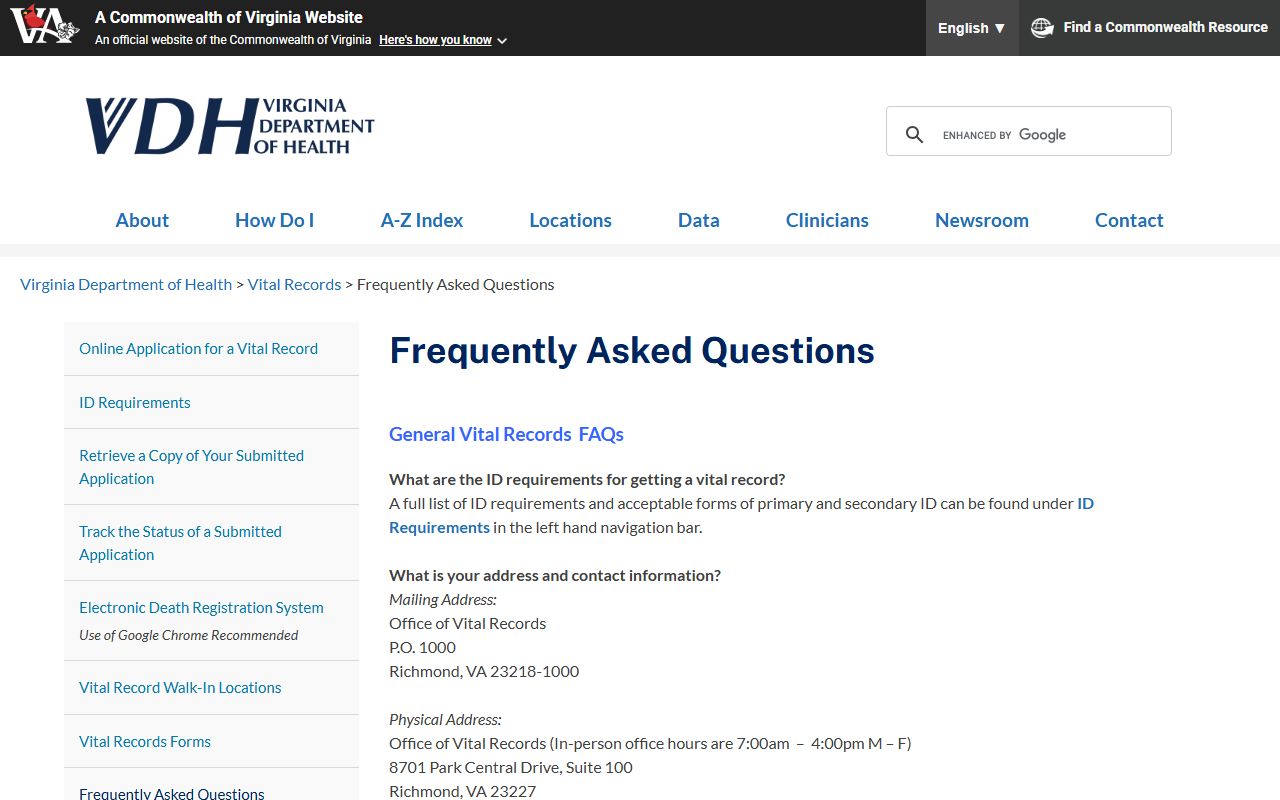
The FAQ addresses specific situations like what to do if you have no primary ID or if an immediate family member needs to request the record on your behalf.
Accepted ID for Virginia Vital Record Requests
Every request for a Virginia vital record requires a legible photocopy of valid identification. The VDH ID requirements page lists all accepted documents. Primary documents include a state-issued photo ID card, driver's license, U.S. military ID card, unexpired U.S. passport or passport card, or a foreign passport. One of these satisfies the requirement on its own.
If you can't provide a primary document, you can use two secondary documents instead. Acceptable secondary items include a military discharge DD214, certified school records or transcripts, a health insurance card, an unexpired weapon or gun permit, a voter registration card, or a utility bill from the past six months. The list of accepted documents can change without prior notice, so it's worth checking the current requirements before you apply. Babies and children don't carry their own ID, so the parent's identification is required for those requests. For online applications, upload a digital scan or photo of your ID rather than mailing the original.
Note: Secondary documents require two items to satisfy the requirement. No single secondary document is enough on its own.
Fees for Virginia Death Records
The fee for a Virginia death certificate is $12.00 per copy, as set by Virginia Code § 32.1-273. This fee applies whether or not the record is found. There is no refund for unsuccessful searches. An additional $10.00 administration fee applies to any amendment or correction to an existing certificate. If you also want a copy of the amended certificate, the total comes to $22.00, which includes both the certificate fee and the amendment fee.
Payment methods vary by request type. Online requests require a credit card. Mail requests use a check or money order made payable to the State Health Department. Walk-in payments at the Richmond office accept cash, check, money order, or any major credit card. The fees the office collects go to the Virginia Vital Statistics Automation Fund under § 32.1-273, which supports the state's records management system. Fee amounts can change, so confirm the current cost before sending payment.
Virginia Death Records Law and Regulations
Virginia's vital records system is governed by Title 32.1, Chapter 7 of the Code of Virginia. This chapter covers the filing, maintenance, and disclosure of all vital records in the Commonwealth. Under § 32.1-263, a death certificate must be filed for every death that occurs in Virginia within three days of the event and before the body leaves the Commonwealth. Certificates filed electronically go through the state's Electronic Death Registration System. Paper certificates are filed with the local registrar in any district across the state.
The Electronic Death Registration System is part of the Virginia Vital Events and Screening Tracking System. It brings together funeral directors, hospitals, nursing homes, physicians, and medical examiners to complete the registration process online. The EDRS handles attended deaths filed by primary care providers, unattended deaths reviewed by a medical examiner, fetal deaths, and donations of bodies to the Virginia State Anatomical Program. Using the system reduces errors and speeds up the time it takes to get a certified copy after a death is filed.
Additional regulations appear in 12 VAC 5-550, the Board of Health Regulations Governing Vital Records. Section 110 of those regulations specifies the exact data required on a death certificate. That includes personal information about the decedent, the medical certification of cause of death, and details about the funeral director and the place of final disposition. Under § 32.1-252, the State Registrar oversees the entire system, sets standards across all counties and cities, and maintains custody of the records.
County and city health directors serve as local registrars of vital records for their jurisdictions under § 32.1-254. They file records with the State Registrar twice monthly. Under § 32.1-272, certified copies issued by the State Registrar carry legal weight as prima facie evidence of the facts they contain. That means courts and government agencies accept them as valid documentation.
Historical Virginia Death Records and Genealogy
For genealogy research, the source you use depends on when the death occurred. Virginia death records from June 1912 to the present are held by the VDH Office of Vital Records. Records from 1853 to 1896 are on microfilm at the Library of Virginia at 800 East Broad Street, Richmond, Virginia 23219-1905. The Archives Division at the Library can be reached at 804-692-3500. Viewing the microfilm is free. If you find a record on the microfilm and want a certified copy, you can request one from the Office of Vital Records for the standard $12.00 fee. The Library of Virginia does not hold birth or death records from the Office of Vital Records for public use after 1896.
There is a gap in the records between 1896 and June 14, 1912. Virginia had no statewide law requiring registration of births and deaths during those years, so records from that period generally don't exist. Events that took place in the part of Virginia that is now West Virginia are held by the West Virginia Division of Culture and History in Charleston, not by the Virginia Office of Vital Records. Records from the Civil War era and earlier deeds, wills, and court documents are also found at the Library of Virginia Archives Division.
The VDH Genealogy page provides an index of open records from 1912 onward for deaths. Death and marriage records become public 25 years after the event. Birth records become public after 100 years. This index is searchable by name and lets you confirm a record is on file before you pay to request a certified copy. The CDC's Where to Write for Vital Records also lists Virginia's contact information for researchers searching from out of state.
The Virginia Office of Vital Records cannot conduct genealogical research on your behalf in person. Submit a written request with specific information about the person so staff can locate the record. For requests based on older microfilm records, check first with the Library of Virginia to confirm the record is on file before ordering a certified copy.
The Library of Virginia holds historical death records on microfilm covering 1853 to 1896 and lets researchers view them at no charge.

The Archives Division at the Library also lends microfilm to other libraries through the Inter-Library Loan Department, so researchers outside Richmond may be able to access records through their local library.
Virginia death records since 1912 are indexed through the VDH genealogy records system, making it easier to search open records without a trip to Richmond.
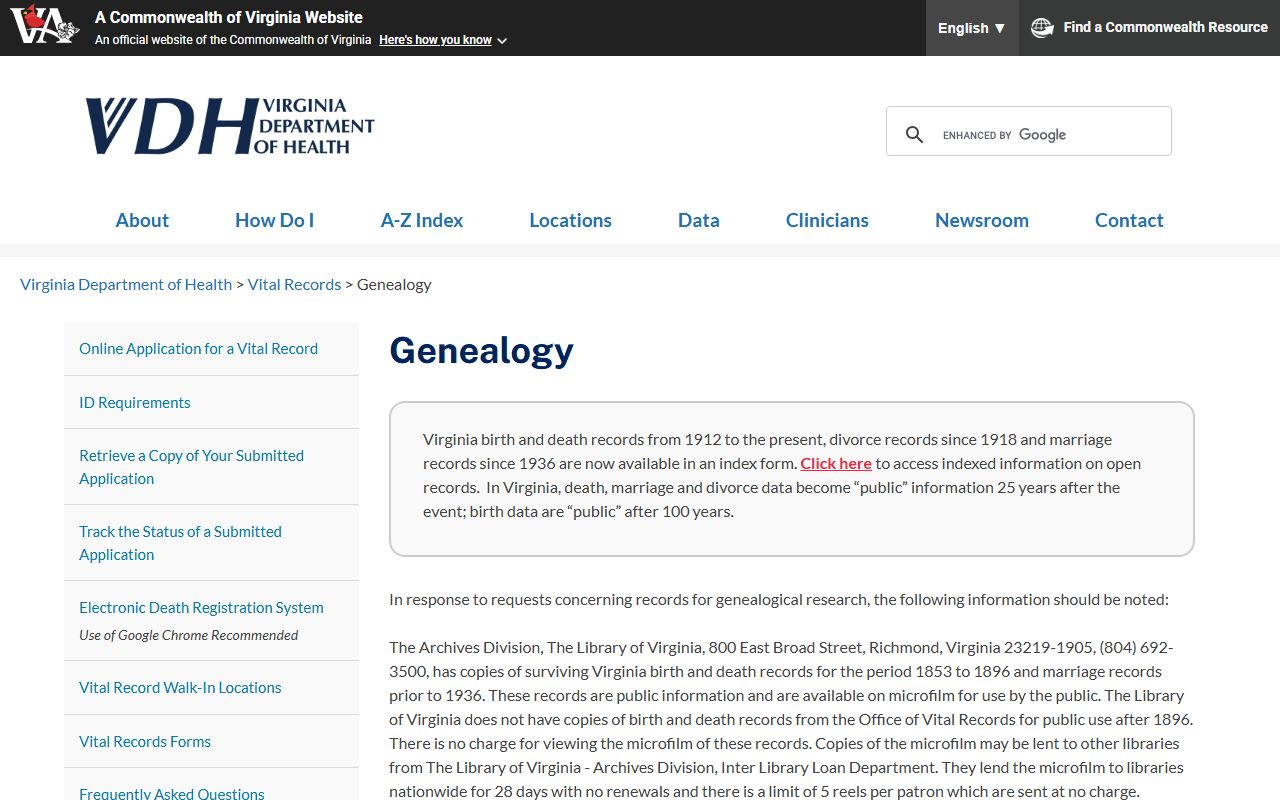
The genealogy index shows whether a record is on file before you pay the $12.00 fee. It covers deaths from 1912 to the present that have passed the 25-year public access threshold.
Virginia Circuit Courts and Death-Related Records
Virginia's circuit courts maintain records connected to deaths in ways that differ from the Office of Vital Records. When someone dies and leaves an estate, the estate goes through probate at the circuit court in the county or city where the person lived. Circuit court clerks keep probate filings, wills, inventories, and other estate documents. These are separate from death certificates and are often important for family members settling an estate or tracing property ownership after a death.
Circuit courts also process court orders that may relate to vital records, including orders to amend a death certificate. If a correction requires court action, the circuit court in the relevant jurisdiction handles that proceeding. The Virginia Judicial System circuit court directory lists clerk contact information, addresses, phone numbers, and hours for every circuit court in the state. Virginia has circuit courts organized into 31 judicial circuits, each covering one or more counties and independent cities.
The Virginia Judicial System circuit court directory covers all counties and independent cities in the Commonwealth, from Accomack to York.
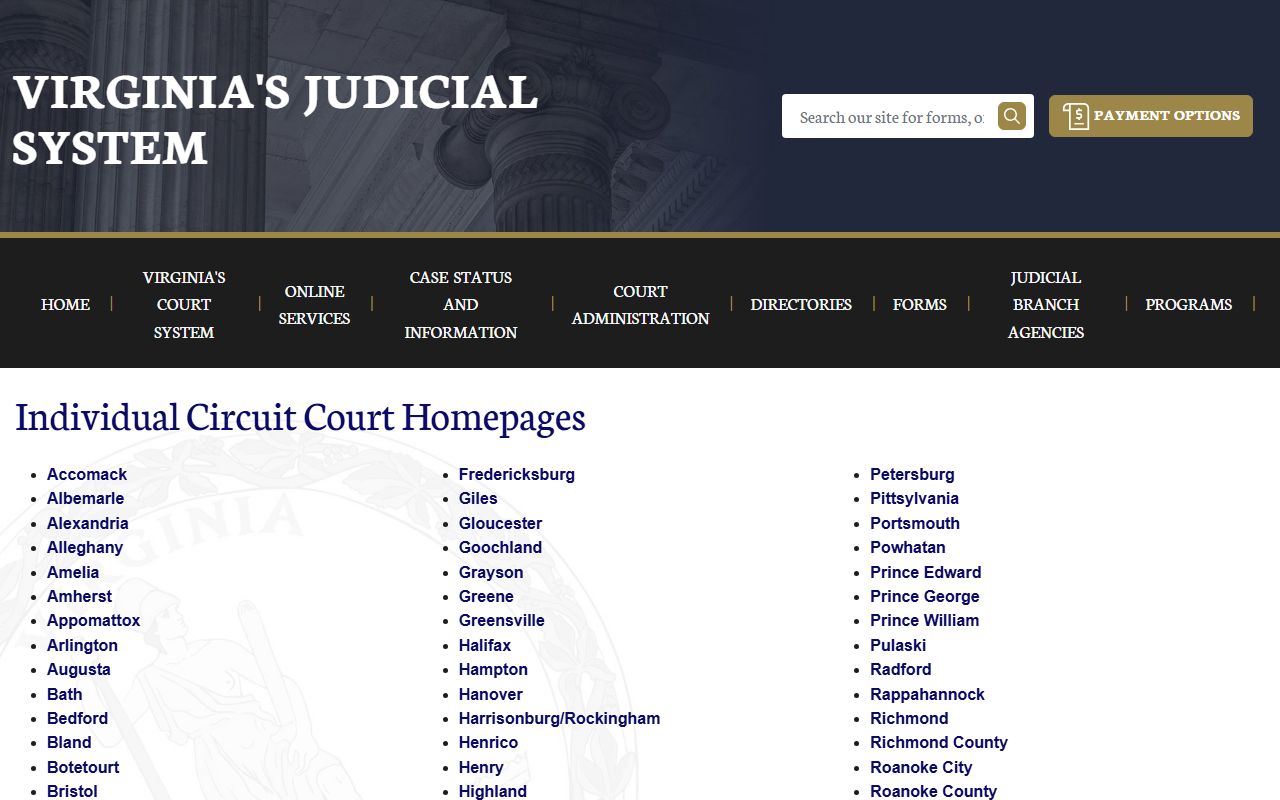
Select the county or city where the death occurred or where the person lived to find the correct circuit court and clerk contact information for estate and probate filings.
Browse Virginia Death Records by County
Each of Virginia's counties has its own circuit court and local health department with access to vital records. Select a county below to find local clerk contact information, VDH health district details, and resources for death records in that area.
Death Records in Major Virginia Cities
Virginia has 39 independent cities, each with its own circuit court separate from the surrounding county. Select a city below to find the circuit court and local health district that handles death records in that area.